
Erik Brynjolfsson is the Jerry Yang and Akiko Yamazaki Professor and Senior Fellow at the Stanford Institute for Human-Centered AI (HAI), and Director of the Stanford Digital Economy Lab. He also is the Ralph Landau Senior Fellow at the Stanford Institute for Economic Policy Research (SIEPR), Professor by Courtesy at the Stanford Graduate School of Business and Stanford Department of Economics, and a Research Associate at the National Bureau of Economic Research (NBER).
His research examines the effects of information technologies on business strategy, productivity and performance, digital commerce, and intangible assets. A best-selling author, he writes and speaks to global audiences about these topics.
Recent Research
Erik Brynjolfsson, Anton Korinek, Ajay Agrawal, “A Research Agenda for the Economics of Transformative AI”, Communications of the ACM, October 2026
Jacy Reese Anthis, Erik Brynjolfsson, James Allen Evans, “Method, Mind, and Morality: How People Make Sense of Artificial Intelligence”, Proceedings of the ACM on Human-Computer Interaction, September 2026
Erik Brynjolfsson, Zoe Hitzig, Avi Goldfarb, “AI’s Use of Knowledge in Society”, University of Chicago Press, September 2026
Xiangning Lin, Shenzhe Zhu, Shu Yang, Zhenyu Zhang, Haoqian Zhang, Yipeng Zhao, Chengxuan Qian, Tianwei Wang, Ziheng Zhang, Zhenlong Yuan, Dingcheng Wang, Juncheng Wu, Yuan Si, Jiaxin Liu, Baolong Bi, Robert Mahari, Tobin South, Dazza Greenwood, Zexue He, Rishi Bommasani, Sophia Kazinnik, Andreas Haupt, Samuele Marro, Erik Brynjolfsson, Alex Pentland, Jiaxin Pei, “AISPA: User-Centric System Prompt Auditing for Large Language Model Applications”, arXiv preprint arXiv:2607.28617, July 2026
Kristina McElheran, Mu-Jeung Yang, Zachary Kroff, Erik Brynjolfsson, “The Adoption of Industrial AI in America”, AEA Papers and Proceedings, May 2026
David Nguyen, Erik Brynjolfsson, Sophia Kazinnik, Avinash Collis, Felix Eggers, “What is Generative AI Worth?”, SSRN 6569938, April 2026
Erik Brynjolfsson, Xijie Gao, David Nguyen, “Measuring Welfare Gains from Digital Variety: Evidence from App-level Time Use in China”, SSRN 6475879, March 2026
Erik Brynjolfsson, J Frank Li, Javier Miranda, Robert Seamans, Andrew J Wang, “Minimum Wages and Rise of the Robots”, NBER Working Paper 34895, February 2026
Ajay K Agrawal, Erik Brynjolfsson, and Anton Korinek, “The Economics of Transformative AI”, University of Chicago Press, 2025
Erik Brynjolfsson, Avinash Collis, Daniel Deisenroth, Haritz Garro, Daley Kutzman, Asad Liaqat, Nils Wernerfelt, “The Consumer Welfare Effects of Online Ads: Evidence from a Nine-Year Experiment”, American Economic Review: Insights, December 2025
Erik Brynjolfsson, Bharat Chandar, Ruyu Chen, “Canaries in the Coal Mine? Six Facts About the Recent Employment Effects of Artificial Intelligence”, Stanford Digital Economy Working Paper, November 2025
Erik Brynjolfsson, John Horton, Christos Makridis, Alex Mas, Adam Ozimek, Daniel Rock, Hong-Yi TuYe, “How Many Americans Work Remotely? A Survey of Surveys and Their Measurement Issues”, The Review of Income and Wealth, October 2025
Dan Hendrycks, Dawn Song, Christian Szegedy, Honglak Lee, Yarin Gal, Erik Brynjolfsson, Sharon Li, Andy Zou, Lionel Levine, Bo Han, Jie Fu, Ziwei Liu, Jinwoo Shin, Kimin Lee, Mantas Mazeika, Long Phan, George Ingebretsen, Adam Khoja, Cihang Xie, Olawale Salaudeen, Matthias Hein, Kevin Zhao, Alexander Pan, David Duvenaud, Bo Li, Steve Omohundro, Gabriel Alfour, Max Tegmark, Kevin McGrew, Gary Marcus, Jaan Tallinn, Eric Schmidt, Yoshua Bengio, “A Definition of AGI”, Center for AI Safety, October 2025
Erik Brynjolfsson, Avinash Collis, W Erwin Diewert, Felix Eggers, Kevin J Fox, “GDP-B: Accounting for the Value of New and Free Goods”, American Economic Journal: Macroeconomics, October 2025
Erik Brynjolfsson, Anton Korinek, Ajay K Agrawal, “A Research Agenda for the Economics of Transformative AI”, NBER Working Paper, September 2025
Matthew O Jackson, Qiaozhu Me, Stephanie W Wang, Yutong Xie, Walter Yuan, Seth Benzell, Erik Brynjolfsson, Colin F Camerer, James Evans, Brian Jabarian, Jon Kleinberg, Juanjuan Meng, Sendhil Mullainathan, Asuman Ozdaglar, Thomas Pfeiffer, Moshe Tennenholtz, Robb Willer, Diyi Yang, Teng Ye, “AI Behavioral Science”, arXiv:2509.13323, August 2025
Erik Brynjolfsson, Alex “Sandy” Pentland, Nathaniel Persily, Condoleezza Rice, Angela Aristidou, “Artificial Intelligence, Democracy and Society”, UCLA Journal of Law and Technology, August 2025
Sophia Kazinnik, Erik Brynjolfsson, “AI and the Fed”, NBER Working Paper, July 2025
Yijia Shao, Humishka Zope, Yucheng Jiang, Jiaxin Pei, David Nguyen, Erik Brynjolfsson, Diyi Yang, “Future of Work with AI Agents: Auditing Automation and Augmentation Potential across the U.S. Workforce”, arXiv preprint, June 2025
Erik Brynjolfsson, Catherine Buffington, Nathan Goldschlag, J Frank Li, Javier Miranda, Robert Seamans, “Robot Hubs and the Use of Robotics in US Manufacturing Establishments”, AEA Papers and Proceedings, May 2025
Erik Brynjolfsson, Danielle Li, Lindsey Raymond, “Generative AI at Work”, The Quarterly Journal of Economics, May 2025
Nestor Maslej, Loredana Fattorini, Raymond Perrault, Yolanda Gil, Vanessa Parli, Njenga Kariuki, Emily Capstick, Anka Reuel, Erik Brynjolfsson, John Etchemendy, Katrina Ligett, Terah Lyons, James Manyika, Juan Carlos Niebles, Yoav Shoham, Russell Wald, Tobi Walsh, Armin Hamrah, Lapo Santarlasci, Julia Betts Lotufo, Alexandra Rome, Andrew Shi, Sukrut Oak, “Artificial Intelligence Index Report 2025”, arXiv preprint, April 2025
Jacy Reese Anthis, Ryan Liu, Sean M Richardson, Austin C Kozlowski, Bernard Koch, James Evans, Erik Brynjolfsson, Michael Bernstein, “LLM Social Simulations Are a Promising Research Method”, arXiv preprint, April 2025
Kristina McElheran, Mu-Jeung Yang, Zachary Kroff, Erik Brynjolfsson, “The Rise of Industrial AI in America: Microfoundations of the Productivity J-curve(s)”, Center for Economic Studies, US Census Bureau Working Papers, March 2025
Sarah H Bana, Erik Brynjolfsson, Wang Jin, Sebastian Steffen, Xiupeng Wang, “Human Capital Acquisition in Response to Data Breaches”, MIS Quarterly, March 2025
Erik Brynjolfsson, Long Chen, Xijie Gao, “Gains from Product Variety: Evidence from a Large Digital Platform”, INFORMS, February 2025
Avinash Collis, Felix Eggers, Erik Brynjolfsson, “LLM Time Machines: Valuing Digital Goods Over Time”, SSRN, December 2024
Kristina McElheran, Mu-Jeung Yang, Erik Brynjolfsson, Zachary Kroff, “The Rise of Industrial AI in America: Microfoundations of the Productivity J-curve(s)”, SSRN, November 2024
Erik Brynjolfsson, Sandy Pentland, Nathaniel Persily, Condoleezza Rice, Angela Aristidou, “Introduction: Artificial Intelligence and Democracy”, Stanford Digital Economy Lab, September 2024
Erik Brynjolfsson, Avinash Collis, Asad Liaqat, Daley Kutzman, Haritz Garro, Daniel Deisenroth, Nils Wernerfelt, “The Consumer Welfare Effects of Online Ads: Evidence from a 9-Year Experiment”, NBER, August 2024
Chiara Farronato, Andrey Fradkin, Bradley J Larsen, Erik Brynjolfsson, “Consumer Protection in an Online World: An Analysis of Occupational Licensing”, AEJ: Applied Economics, July 2024
Wajeeha Ahmad, Ananya Sen, Charles Eesley, Erik Brynjolfsson, “Companies inadvertently fund online misinformation despite consumer backlash”, June 2024
Sinan Aral, Erik Brynjolfsson, Chris Gu, DJ Wu, “Understanding the Returns from Integrated Enterprise Systems: The Impacts of Agile and Phased Implementation Strategies”, June 2024
Nestor Maslej, Loredana Fattorini, Raymond Perrault, Vanessa Parli, Anka Reuel, Erik Brynjolfsson, John Etchemendy, Katrina Ligett, Terah Lyons, James Manyika, Juan Carlos Niebles, Yoav Shoham, Russell Wald, Jack Clark, “Artificial intelligence index report 2024”, May 2024
Erik Brynjolfsson, Wang Jin, Sebastian Steffen, “Do IT Capabilities Still Drive Productivity and Innovation in the Digital Age?”, SSRN 4765508, March 2024
Wajeeha Ahmad, Ananya Sen, Chuck Eesley and Erik Brynjolfsson, “The Role of Advertisers and Platforms in Monetizing Misinformation: Descriptive and Experimental Evidence”, NBER WP 32187, March 2024
Kristina McElheran, J. Frank Li, Erik Brynjolfsson, Zachary Kroff, Emin Dinlersoz, Lucia Foster, and Nikolas Zolas, “AI adoption in America: Who, what, and where”, Journal of Economics & Management Strategy, January 2024
Sagit Bar-Gill, Erik Brynjolfsson, and Nir Hak, “Helping Small Businesses Become More Data-Driven: A Field Experiment on eBay”, Management Science, January 2024
Erik Brynjolfsson, Gabriel Unger, “The Macroeconomics of Artificial Intelligence”, IMF, December 2023
Erik Brynjolfsson, Robert M. Wachter, “Will Generative Artificial Intelligence Deliver on Its Promise in Health Care?”, JAMA, November 2023
Martin Neil Baily, Erik Brynjolfsson, and Anton Korinek, “Machines of mind: The case for an AI-powered productivity boom”, Brookings, May 2023
Erik Brynjolfsson, Danielle Li, Lindsey Raymond, “Generative AI at Work”, NBER WP 31161, April 2023
Nestor Maslej, Loredana Fattorini, Erik Brynjolfsson, John Etchemendy, Katrina Ligett, Terah Lyons, James Manyika, Helen Ngo, Juan Carlos Niebles, Vanessa Parli, Yoav Shoham, Russell Wald, Jack Clark, and Raymond Perrault, “The AI Index 2023 Annual Report,” AI Index Steering Committee, Institute for Human-Centered AI, Stanford University, Stanford, CA, April 2023
Sagit Bar-Gill, Erik Brynjolfsson & Nir Hak, “Helping Small Businesses become more Data-Driven: A Field Experiment on eBay”, NBER WP 31089, March 2023
Erik Brynjolfsson, Cathy Buffington, Nathan Goldschlag, J. Frank Li, Javier Miranda & Robert Seamans, “The Characteristics and Geographic Distribution of Robot Hubs in U.S. Manufacturing Establishments”, NBER WP 31062, March 2023
Erik Brynjolfsson, Long Chen & Xijie Gao, “Gains from Product Variety: Evidence from a Large Digital Platform”, NBER WP 30802, December 2022
Brynjolfsson, Erik, “The Turing Trap: The Promise & Peril of Human-Like Artificial Intelligence,” Dædalus, Spring 2022.
Erik Brynjolfsson, Karthik Rajkumar, Guillaume Saint-Jacques, Iavor Bojinov, Sinan Aral, “A causal test of the strength of weak ties,” September 2022.
Daniel Zhang, Nestor Maslej, Erik Brynjolfsson, John Etchemendy, Terah Lyons, James Manyika, Helen Ngo, Juan Carlos Niebles, Michael Sellitto, Ellie Sakhaee, Yoav Shoham, Jack Clark, Raymond Perrault, “The AI Index 2022 Annual Report,” AI Index Steering Committee, Institute for Human-Centered AI, Stanford University, Stanford, CA, May 2022
Brynjolfsson, Erik, Liu, Meng, Westerman, George, “Do Computers Reduce the Value of Worker Persistence?,” April 2022.
Erik Brynjolfsson, John Horton, Christos A. Makridis, Alex Mas, Adam Ozimek, Daniel Rock, and Hong-Yi TuYe (2022) “How Many Americans Work Remotely?,” Stanford Digital Economy Lab Working Paper, March 22.
Benzell, Seth and Brynjolfsson, Erik, “The Innovation-Complexity Trade-off: How Bottlenecks Create Superstars and Constrain Growth,” January 2022.
Benzell, Seth, Brynjolfsson, Erik, and Saint-Jacques, Guillaume, “Digital Abundance Meets Scarce Architects: Implications for Wages, Interest Rates, and Growth,” January 2022.
Recent Books


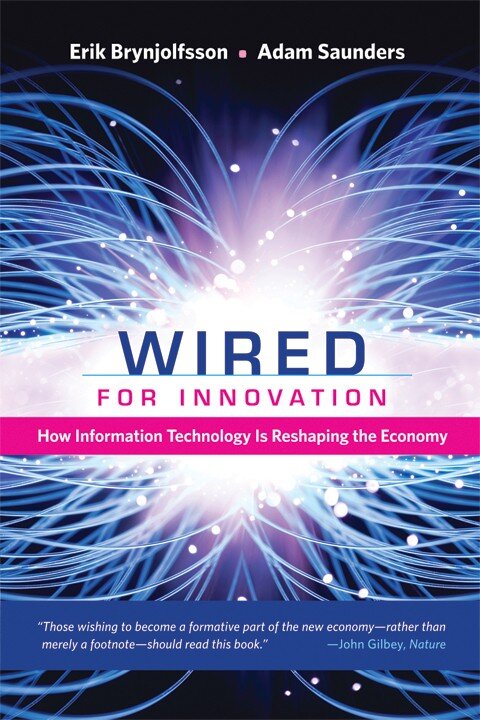
In The News
A top economist who studies AI says it will double productivity in the next decade: ‘You need to embrace this technology and not resist it’
Fortune - September 26, 2023
How to Capitalize on Generative AI
Harvard Business Review - November-December 2023
Erik Brynjolfsson: ‘This could be the best decade in history — or the worst’
Financial Times - January 30, 2024
Companies Using AI to Replace Workers Will Lose: Stanford Professor Says
Business Insider - January 17, 2024
Workers with less experience gain the most from generative AI
MIT Sloan - June 26, 2023
Stanford Professor Erik Brynjolfsson on How AI Will Transform Productivity
Microsoft Worklab - March 22, 2023
In Reversal Because of A.I., Office Jobs Are Now More at Risk
The New York Times - August 24, 2023
This company adopted AI. Here's what happened to its human workers
NPR - May 2, 2023